Posted in supplementary material

Episode 14 Follow-Up: A+ Leaders Who Are Also Women

(By Martha S.)

You may have deduced by now that gender portrayals are important to me in the media I consume – I am very prone to loving things that feature fully-realized, interesting, multifaceted women (notice I did not say “strong” – strength means many things, and I am just as likely to love a female character who is whiny and evil as I am to love one that is strong and likable). The gender disparity in the materials we talked about last week is bugging me, because I do try to pick media for the show that presents a range of experience and characters and obviously I need to do better. With that in mind, here is a bevy of women who lead in some way, whether successful or not, charismatic or not, likable or not. Because it is important to remember that while there are obviously brilliant and inspiring women leaders in fiction, there are also women who fail, and their failure as leaders does not equal their failure as characters.

Wynonna Earp, Wynonna Earp (2016 tv show by showrunner Emily Andras and starring Melanie Scrofano)
Long have I searched for a show that could ease the Supernatural-shaped hole in my heart, ever since it went to hell and I realized it hated women. Wynonna Earp seems to be doing just that. In brief, the titular character, the great-granddaughter of the infamous Wyatt Earp, is back in her hometown with Earp’s gun and a mission: kill the outlaws Earp originally laid to rest, who are cursed to come back from the dead every time the heir to the Earp name dies and the mantle is passed to a new heir. Wynonna is a booze-soaked, vulgar, rude, and frequently selfish character and I love her – she’s also becoming an increasingly more effective leader of her ragtag support group with every episode. The qualities that make Wynonna worthy of following? Pragmatism, street smarts, efficiency, and a strong sense for when her people need to take a break (also her little sister Waverly is the best and cutest exposition-fountain anyone could ask for).

Mirabel, Arsinoe, and Katharine, Three Dark Crowns (novel by Kendare Blake)
This fantasy YA novel features three wanna-be queens engaged in a fatal battle for supremacy. In the world of the novel, when the queen of Fennbirn dies, the crown is passed on to one of three sisters – each has a magical gift that they use to try and eliminate their competition. In Three Dark Crowns, the perspective rotates amongst the three sisters, who each are raised by a different group of people and trained to rule. It’s an effective story about the people who shape leaders, the influence they can have, and how a potential leader can either mitigate or succumb to that influence. By the end any one of them could be an effective Queen (although you’re getting very different flavors of leadership: clear and direct from Arsinoe, traditional and regal from Mirabel, cunning and grabbing from Katharine).

Eadlyn Schreave, The Heir (novel by Kiera Cass)
Gonna put this out right in front: The Selection novels (of which this is technically #4) are cotton candy novels. They are wonderful fluff. They are full of romance and pretty dresses and sometimes occasionally Cass remembers there’s kind of a story? This is more true in The Heir and its follow-up The Crown, wherein Princess Eadlyn is conducting her version of The Bachelor and also learning how to be Queen. I will also put this out front: Eadlyn is a TERRIBLE leader. She has no sense of how to inspire loyalty, is incredibly entitled, has no work-life balance, and can’t read a room to save her life. She’s intellectually intelligent and completely people-stupid. I would argue that the novels she stars in are actually the story of someone realizing they should absolutely not step into a leadership role, finding an alternative, and implementing that, rather than the story of someone learning how to be Queen.

Dorothy Vaughn, Hidden Figures (2016 film directed by Theodore Melfi and starring Taraji P. Henson, Octavia Spencer, and Janelle Monae)
I’m singling out Octavia Spencer as Vaughn in particular because she’s in charge of the team that Henson and Monae begin the film working out of. She’s overworked, underpaid, and has no guarantee that she’ll ever get the recognition she deserves – but she still identifies a threat to her staff, learns its ins and outs, teaches her staff the skills necessary to operate the giant computer, and makes them all instantly indispensable. Not only is Vaughn capable, intelligent, and resourceful, but she cares about the women who work with her, and goes extra lengths to ensure they have job security as well. Everyone in Hidden Figures is admirable, but Spencer brings a steely determination to Vaughn that I found incredibly admirable.

Posted in episodes

Episode 13: Fandom in Media

The homework for the episode:
Martha: Fangirl by Rainbow Rowell
Calee: Fanboys, 2009 film directed by Kyle Newman
Pete: Galaxy Quest, 1999 film directed by Dean Parisot

A new freshman in college finds refuge from all the change in her life in the book series she’s loved for years, and the fanfiction she writes for it.

A group of friends embark on a cross-country road trip to break into Skywalker Ranch so their dying friend can see The Phantom Menace before he goes.

The cast from a classic sci-fi tv show are recruited to help a very real group of aliens defeat the nemesis that slaughtered their people.

Today’s episode is brought to you by fanculture everywhere. Join us as we take a deep dive into fandom and how media portrays it, from the perspective of male and female fans and even a bit from the creator side.

Your podcasters’ credentials:

Pete: Two YouTube videos: Angelo Badalamenti describes creating “Laura Palmer’s Theme” from Twin Peaks and Alex Jones as Bon Iver
Martha: Watching her husband play Serial Cleaner
Calee: Mouseguard: Legends of the Guard by David Peterson

Pete cheats YET AGAIN, Martha is basically living inside a Twitch stream, and Calee has discovered the wonderful world of anthropomorphized mice. (J/K she’s probably read Redwall before.)

Thoughts to Think on for The Hero’s Journey

  1. Is fandom portrayed generally positively or negatively in the homework we discuss?
  2. What does fandom add to the conversation surrounding a piece of pop culture?
  3. What, if any, responsibility do creators have toward their fans?
  4. Why is fandom relevant? Why should we care?

We are all fans of something, but it is fair to say that we were NOT fans (ha) of Fanboys, although it provides a rich vein in which to explore toxic fandom and how deeply, deeply dated pop cultural humor can be. We get a little side-tracked and don’t fully explore the idea of plagiarism, copyright infringement, and fanworks, although Martha is willing to admit she’s a big ol’ hypocrite when it comes to Teefury t-shirts. We do finish strong by touching on the relevancy of fandom and how it has moved out of the dark corners of geekdom and into the light because hey, we’re all fans of something around here. (We also get through the entire episode without talking about The Big Bang Theory, which I’m counting as a win.)

Next episode, Pete’s taking us on a guided tour of what it means to be a good leader, what being a bad leader means for a group or organization, and in general, Leaders and Leadership. Plus Martha’s making you read ANOTHER book (but this one’s for kids, and it’s great). Have fun doing your homework!

Your homework for August 2:
Martha: Mrs. Frisby and the Rats of NIMH by Robert C. O’Brien
Calee: Firefly, episode 1.09: “Ariel”
Pete: Superman: Red Son by Mark Millar

And remember, if you have questions, comments, or ideas for a show, give us a shoutout here or send us an e-mail to show@homeworkpodcast.com. We’d love to hear from you!

Posted in syllabus

Hero’s Journey: Syllabus

Chapter 19 of The Silmarillion, Beren and Luthien (1977 novel written by J.R.R. Tolkien, and edited by Christopher Tolkien)

The Book of Life (2014 movie directed by Jorge Gutierrez)

The Hero With a Thousand Faces (1949 book by Joseph Campbell)

Mass Effect 1, 2, 3 (Bioware video game series first released in 2007)

Pokemon (Series of Nintendo video games first released in 1996 for the Nintendo Gameboy)

The Power of Myth (1988 documentary and subsequent book published in 1988)

Shrek (2001 movie directed by Andrew Adamson and Vicky Jenson)

Star Wars (1977 film directed by George Lucas and starring Mark Hamill, Harrison Ford, and Carrie Fisher)

Tomb Raider (Crystal Dynamics video game released in 2013)

Posted in episodes

Episode 12: The Hero’s Journey

The homework for the episode:
Pete: “Of Beren and Luthien,” chapter 19 of The Silmarillion
Martha: The Book of Life, 2014 animated film directed by Jorge R. Gutierrez
Calee: Shrek, 2001 animated film directed by Andrew Adamson and Vicky Jenson

Two lovers forced to perform impossible tasks before earning their happily-ever-after.

A bullfighter-turned-musician embarks on a magical journey through the land of the dead to reunite with his living love and save his town.

An ogre steps up to reclaim his swamp and finds more than he bargained for on the way.

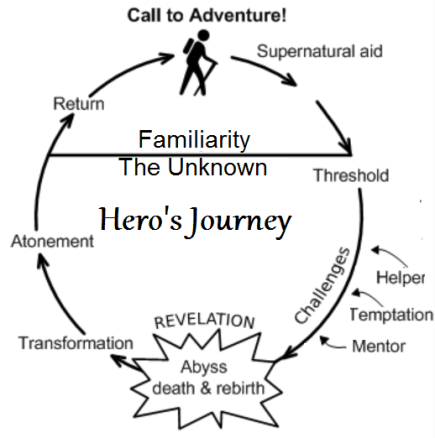
The hero’s journey as a storytelling map has been part of human culture for thousands of years. Joseph Campbell codified it in The Hero With the Thousand Faces, and when illustrated by infographic, it looks a little something like this:

The_Hero's_Journey

The hero’s journey can be broken down into three necessary stages and seventeen substages, because Joseph Campbell is a categorizing animal with an answer to everything. As we note in the episode, not all of these substages show up in every hero’s journey, and frequently they get shuffled around a bit as the story calls for it. In convenient outline form:

  1. Departure
    1. Call to Adventure
    2. Refusal of the Call
    3. Crossing the First Threshold
    4. In the Belly of the Whale
  2. Initiation
    1. Road of Trials
    2. Meeting with the Goddess
    3. Temptations
    4. Atonement with the Father
    5. Apotheosis
    6. The Ultimate Boon
  3. Return
    1. Refusal of the Return
    2. The Magic Flight
    3. Rescue from Without
    4. Crossing the Return Threshold
    5. Master of Two Worlds
    6. Freedom to Live

Your podcasters’ credentials:

Pete: Embassytown by China Mieville
Martha: Bondi Ink Crew on Netflix
Calee: Real Genius

We take a brief detour down the rabbit hole of Val Kilmer’s IMDB page, Martha talks tattoos and Pete is involved in speculative fiction.

Thoughts to Think on for The Hero’s Journey

  1. Admittedly, the hero’s tale is a very formulaic one. How does this aid the narrative, and how does it hinder it? If a tale diverges from this, is it considered better or worse?
  2. Are we cheapening the act of the Return of the hero? Does it mean as much when we expect it?
  3. Why has the hero’s journey become this lasting, resonant storytelling structure?

A lot of our discussion circles around the question: how does a storytelling structure that is so ingrained in us do anything new or innovative? Using Tolkein, Shrek, and an animated celebration of the Day of the Dead (The Book of Life, hey-o) we talk about the elements that make up the archetypal hero’s journey and why it’s important to understanding the way we have and continue to tell stories. We also briefly mention Star Wars, because honestly, I don’t think you can talk about the hero’s journey without at least touching on it.

I dug up this article about why the hero’s journey has particular resonance and staying power, particularly from the perspective of someone creating stories: “Writing and the Importance of the Hero’s Journey,” by Evelyn Bertrand.

Next episode, we’re taking things in a little lighter direction and discussing fandom and how it gets treated by media. Join us for our chat on Fandom in Media and enjoy doing your homework!

Your homework for July 19:
Martha: Fangirl by Rainbow Rowell
Calee: Fanboys, 2009 film directed by Kyle Newman
Pete: Galaxy Quest, 1999 film directed by Dean Parisot

And remember, if you have questions, comments, or ideas for a show, give us a shoutout here or send us an e-mail to show@homeworkpodcast.com. We’d love to hear from you!

Posted in syllabus

Grief and Grieving: Syllabus

The Babadook (2014 film directed by Jennifer Kent and starring Essie Davis)

Deep Dark Fears (webcomic by Fran Krause, located here)

The Fox and the Hound (1981 animated film directed by Ted Berman, Richard Rich, and Art Stevens)

Frankenweenie (1984 film directed by Tim Burton)

Hannibal, episodes 1.04 (Ouef), 1.09 (Trou Normand), 2.12 (Tome-Wan), and 3.02 (Primavera) (2013 TV series produced by Bryan Fuller)

iZombie, episode 3.10 (Return of the Dead Guy) (currently airing TV show created by Diane Ruggiero and Rob Thomas, and starring Rose McIver)

The Orphanage (2007 film directed by J.A. Bayona and starring Belen Rueda)

The Others (2001 film directed by Alejandro Amenabar and starring Nicole Kidman)

Pet Sematary (1983 novel written by Stephen King)

Scrubs, episodes 5.20 and 5.21 (2001 TV show created by Bill Lawrence)

The Skeleton Tree (2016 musical album by Nick Cave and the Bad Seeds)

Song of the Sea (2014 animated film by Tomm Moore)

Spontaneous (2016 novel by Aaron Starmer)

Supernatural, episodes 1.01 (Pilot), 2.01 (In My Time of Dying), 2.02 (Everybody Loves a Clown), and 2.20 (What Is and What Should Never Be) (Currently airing TV show, created by Eric Kripke)

Posted in supplementary material

Grief and Horror: Episode 11 Follow-Up

(Written by Martha S.)

Last week, we discuss in detail some of the broad ways that media handles grief and characters who are grieving, as well as how creators grieve through their work. The media we chose to assign for the episode all falls broadly under the umbrella of realistic fiction (Spontaneous perhaps has a touch of science fiction about it? Maybe if you stretch), and I want to address another genre that is saturated with grief and loss and the way people deal (or don’t deal) with those things: horror.

The easiest and most disingenuous way to describe horror, whether it’s in film or book form, is “something that causes fear.” I say this knowing that I myself have used that as shorthand, or as a way to distill the genre down to something classifiable (one of my job duties is purchasing and categorizing DVDs at the library that I work at, and when you only have seven genres on the shelf, you have to make some generalizations somewhere), but the reality is that while this is true, horror is much more multifaceted than that. What I want to talk about specifically is horror media driven by grief, and frequently also driven by guilt.

Frequently, in supernatural horror where the main character is haunted by a specter of some sort, that specter (whether it’s a ghost, monster, or other) is anchored to the protagonist by some kind of strong feeling or catastrophic event. Guilt is a powerful emotion, particularly when coupled with grief – say, over a loved one dying, or causing death either accidentally or purposefully (see: Dr. Cox’s breakdown in Scrubs). The protagonist is haunted, both literally and metaphorically, by the specter of their grief, until they confront their guilt and lay it to rest. Then, if the story has a happy ending, they can move on with their lives; if it does not, it may mean the protagonist is consumed (again, both literally and metaphorically) by their grief.

Horror stories can be cathartic to consume. I recommend this article by Aaron Orbey from the New Yorker on the subject, who speaks much more eloquently on using horror film as a way to exorcise one’s own feelings of loss than I ever could. Suffice to say, horror stories can provide us the same tools that all media dealing with grief can, with the added layer of being able to watch someone plagued by demonic horrors and say “at least I have it better than they do.”

Supplementary Materials

The Babadook (2014 film directed by Jennifer Kent and starring Essie Davis)
Not just a gay icon, The Babadook is also a portrait of a woman suffering the extreme grief over the death of her husband, guilt at her survival, and guilt over the way this death has come between her and her son. The titular monster is the tremendous and insatiable embodiment of her grief, guilt, and rage at herself, and **spoilers** doesn’t totally go away at the end of the film. Rather than exorcising this demon completely, Amanda learns to live with it, which is the reality most of us face with our own feelings of grief – they never truly go away, they just become easier to deal with.

Hannibal
Hahaha OH HANNIBAL. There are a couple of different incarnations of the character I could talk about, but I’m going to focus on the tv series, since the way they play with expectations on dealing with grief is just absolutely fascinating. We learn early on that Hannibal Lecter had a sister, who died – he mentions her to Abigail in episode 1.04, Oeuf, when he is talking about wanting to rewind time and “put the teacup back together,” as it were. Lecter’s whole deal (cannibalism included) can be taken as him dealing with the death of his sister – except that he himself refuses to be distilled down to a childhood trauma, which is more closely examined in season 3.

Aside from being the main general destructive force in the show, Hannibal also causes a number of very personalized losses, which he then orchestrates the recovery of in some breathtaking feats of gaslighting and brainwashing (note: Hannibal is not a show about recovering from grief in a healthy manner). I desperately want to assign episodes of this show as homework, so I’m gonna stop there, but suffice to say, Will Graham’s eternal grief over his job, the loss of Abigail, and all the second-hand grief he takes upon himself is about 75% of the show (the rest is beautiful, cannibalistic food portraiture).

iZombie 3.10: Return of the Dead Guy (currently airing CW tv show created by Diane Ruggiero and Rob Thomas, and starring Rose McIver)
In case you’re unfamiliar with the premise of this delightful show, Rose McIver stars as Liv Moore, a former medical student-turned-medical examiner for the Seattle P.D. after a disastrous party ends with her being turned into a zombie. Now, she helps solve crimes by eating the brains of murder victims and seeing visions of their past. This particular episode is of note because the brain she eats causes her to hallucinate her dead ex-boyfriend, who she was forced to kill after he went into full-on zombie monster mode (which there’s no coming back from). Liv gets the chance to face the guilt she feels over pulling the trigger, while acknowledging that it was the only, and the right, thing to do.

On a macro level, the show deals with Liv coming to terms with the loss of her human life, and finding a way to move forward without the emotional touchstones she has relied on for that life (including her family and ex-fiance).

The Orphanage (2007 film directed by J.A. Bayona and starring Belen Rueda)
We’ve already talked about The Orphanage on our very first episode, but it’s worth bringing up again because of how strongly Laura is motivated by the grief of losing her son – and also how the specter of another woman’s grief sets the wheels turning on the story in the first place.

The Others (2001 film directed by Alejandro Amenabar and starring Nicole Kidman)
**THIS WHOLE PARAGRAPH IS SPOILERS** This film is a pretty delightful inversion of the “haunted by guilt” idea, in that Nicole Kidman is actually haunting herself – the reveal at the end that she and her children are dead because of her (she killed them in a maddened haze and then shot herself) throws the rest of the movie, where she believes they’re being haunted by an invasive presence, into much sharper relief. This is another story where coming to terms with one’s grief doesn’t make the specter go away, but simply allows the grieving individual to accommodate the grief in an (arguably?) healthier fashion. Kidman may not be able to lay herself to rest, but she can at least stop denying the tragedy happened, and move forward in her ghostly way.

Pet Sematary (1983 novel written by Stephen King)
This Stephen King novel was made into a film, but since I’ve never seen it I’m going to be talking about the original novel. While Pet Sematary is not my favorite of King’s work by an order of magnitude, it fits our conversation here to a tee: Louis Creed learns of a cemetery where the things buried in it come back to life. He buries his cat there, to find that the beings that come back are monstrous versions of themselves – this does not prevent him from trying the same thing with his two-year-old son, who spends the last third of the book terrorizing the Creed family and ultimately killing his mother, Rachel. This book provides a solid example of what happens when the protagonist is unable to overcome their grief, as Louis, despite all evidence pointing to the terrible outcome, tries the resurrection AGAIN with his wife – who, the ending implies, also comes back as a monstrous shadow of herself.

Supernatural, the early seasons
The core of this show is Dean and Sam running away from their feelings under the guise of enacting vengeance on the forces that have been taking away their loved ones. It’s hard to anchor an infinitely long-running show on this, so it does wander from time to time, but the truth of Supernatural is of two men that are terrible at accepting and moving on from their grief. For more specific examples, I recommend episodes 1.01 (Pilot), 2.01 (In My Time of Dying), 2.02 (Everybody Loves a Clown), and 2.20 (What Is and What Should Never Be).

Posted in episodes

Episode 9: Strange Bedfellows

A note from your podcasters: you’ll notice our episode is slightly different this week! In order to bring you the best content possible, we’re streamlining our discussion and shifting focus from trying to generate a syllabus of materials in the episode, to generating a lesson plan of Big Ideas that you can address using the media we assign as homework. Follow-up blog posts will include more media on the theme as usual, but more from us about how they connect to the podcast. 

Feedback is, as always, more than welcome! Tweet us at @DYDYHpodcast or e-mail us at show@homeworkpodcast.com to let us know your thoughts on our new direction.

The subtitle for this episode is basically “radical empathy,” which is the theme a lot of these stories boil down to and a very useful thing to be teaching!

The homework for the episode:
Pete: Good Omens, 1990 novel cowritten by Terry Pratchett and Neil Gaiman
Martha: Anya’s Ghost, 2011 graphic novel by Vera Brosgol
Calee: The Man from U.N.C.L.E, 2015 film by Guy Ritchie

What exactly do we mean when we say “Strange Bedfellows”? If you didn’t get it from the homework context clues, we’re talking weird character matchups between people who have absolutely nothing in common – or DO they? We get down and dirty on the subject of odd couples, weird matchups, character growth and something Pete has dubbed “Radical Empathy.” Our homework takes us from ghosts to the apocalypse, from the Cold War to first generation Russian immigrants, and from the idyllic English countryside to 1960’s Rome in our search for commonality. What we find may shock you! (It won’t, but it does end up being quite interesting.)

Your podcasters’ credentials:
Pete: I Love You, Honeybear by Father John Misty (album)
Martha: Batgirl and the Birds of Prey, vol. 1: Who is Oracle? by Shawna and Julie Benson, and Roge Antonio and Claire Roe (DC Rebirth trade paperback)
Calee: Mystery Science Theater 3000: Cry Wilderness (Netflix incarnation)

Martha is digging hard on the DC Rebirth incarnation of the Birds of Prey, while Pete feels only lukewarm on the new musical offering from Fleet Foxes alum Father John. Calee has never seen MST3K before (author’s note: WHAT), but the new stuff sounds pretty great.

Strange Bedfellows: Big Ideas
– Radical Empathy: using media examples to teach empathy and understanding
– Determining the appeal of “strange bedfellow” relationships, through what they reveal about a character (and by extension the consumer by proxy)
– The idea of living in an “echo chamber” (slightly rehashed from our episode on News Media): how absorbing the viewpoints and opinions from others can expand your worldview
– The difference between understanding and empathy, and why it matters

We briefly mention a comic from the popular blog The Oatmeal, “You’re Not Going to Believe What I’m About to Tell You.” Read it here, it’ll be good for you.

Our theme for our next episode is going to be: Pop Culture Depictions of Mental Health. Enjoy doing your homework!

Your homework for May 24:
Pete: Spellbound, 1945 film by Alfred Hitchcock (watch it in its entirety on YouTube here)
Martha: Legion, episodes 1 and 2 (2017 show on F/X)
Calee: Hyperbole and a Half, Adventures in Depression parts 1 and 2 by Allie Brosh (located here and here)

And remember, if you have questions, comments, or ideas for a show, give us a shoutout here or send us an e-mail to show@homeworkpodcast.com. We’d love to hear from you!

Posted in extra credit

Alternative Facts Follow-Up

(Written by Martha S.)

I wanted to follow up our episode on news media with a short discussion of why I picked the topic to begin with. As I have said on the podcast many times, I’m a librarian, and specifically I am a teen services librarian. One of the foundations of my profession is providing access to, and helping people find, reliable information, a principle which is more important than ever these days and particularly for teens, who are far less likely to go beyond their curated social media feeds to find alternate or corroborative sources of information. Teaching information literacy is no longer optional for librarians, it is a necessity. Because of that, I thought it would be useful for us to look at how pop culture presents the news and journalism, and how we react to that.

This past Saturday, Melissa McCarthy returned to SNL to reprise her role as Sean Spicer. Her portrayal has been brilliant, I think it’s fair to say, and highlighted something about the way Spicer is dealing with his role as the disseminator of information for an administration that tells us nothing but lies: hostilely. Spicer, and our current White House, are our antagonists, and they are helping foster a culture of distrust and skepticism when it comes to the news. Our first reaction is to assume that he’s lying (because he is).

One of the things I thought was striking about all the homework we talked about in this episode was that the news sources in them are treated first and foremost as being trustworthy, and then only later shown not to be: CJ is a trustworthy source of information, which is how she gets away with sidelining stories that should be a bigger deal. The Daily Prophet can spread misinformation about Harry Potter because it has a reputation for telling the truth. No one questions Glass’ articles because the New Republic has a good reputation. When we find out those things aren’t true (in the case of The West Wing, we see this develop over the course of the episode), we are meant to feel betrayed. This isn’t how the news is supposed to work! And yet, it does, and recently, it does often and without shame.

Anyway, I don’t really have any more profound thoughts than that I’m sad that our news media culture has turned into one of distrust and hostility. I don’t think it’s new, clearly news has always been a cultivated experience for us so that the people in charge can control the way the population thinks and feels about things (which sounds WAY more 1984 than I thought it would, yikes). I hope some day we get back to a place where I can read a headline and not feel the urge to cross-check in on four other sites, if for no other reason than that I don’t have time for that every day.

Supplementary Materials

Lois Lane: Fallout
The first Lois Lane YA novel by Gwenda Bond, this series follows a teenage Lois as she investigates and exposes scandals for her high school newspaper. Clark Kent shows up only occasionally as a texting partner for Lois to bounce ideas off of, which is really the best use for Clark. I mentioned (awkwardly) in the episode that the relationship between journalism and superheroes is fascinating to me, and it’s fun to read about one of comics’ most famous journalists in her nascent teenage years.

Wag the Dog
A 1997 film directed by Barry Levinson that shows some truly epic misdirection from a president’s shenanigans (Dustin Hoffman invents a war in actual 1984 style to take attention away from a president’s sex scandal, and oh man do I wish that our president would actually be punished for a sex scandal to the magnitude that would necessitate a fake media war).

“Waiting on the World to Change” by John Mayer
Political music was something we didn’t really have a chance to touch on in the episode, and maybe that’s because it wasn’t totally germane to the conversation. Music, after all, doesn’t really get used as a delivery tool for news – it can’t be timely enough. The closest it gets, I think, is as a way for musicians to enter the news conversation; it’s commentary on the environment rather than an informative source itself. But I appreciate deeply the lyrics from this song (despite not being a huge fan of John Mayer), particularly the lines “And when you trust your television/ What you get is what you got/ But when they own the information/ they can bend it all they want.”

Posted in episodes

Episode 7: Alternative Facts, or, How We Relate to News Media

The homework for the episode:
Pete: The West Wing, episode 1.13: “Take Out the Trash Day”
Martha: Shattered Glass, 2003 film starring Hayden Christensen
Calee: Harry Potter and the Order of the Phoenix by J.K. Rowling (book)

Martha uses the podcast as a thinly veiled excuse to watch Shattered Glass again, and to plumb the depths of Slate to read about the real world scandal. Pete is way more politically savvy than anyone else in the room (natch), and Calee keeps us all grounded by reminding us that teenagers really are the future of the resistance (a thematic callback to Episode 2, even if we all forgot to point that out!). Martha ALSO awkwardly shoehorns in a discussion about superheroes and news coverage of vigilantism, but maybe it comes out all right in the end?

Your podcasters’ credentials:
Pete: Cheated and has two, but we’ll forgive him since Knox Fortune, the talent behind the single “Help Myself” is his little brother. Also the Legion playlist on Spotify.
Martha: Brave Chef Brianna, issue no. 1, by Sam Sykes and Selina Espiritu
Calee: Tangled: the Series, episode 4

Alternative Facts – Additional Material
All the President’s Men (film)
Daredevil, 1.11 and 1.12 (Netflix tv show)
“Paparazzi” by Lady Gaga (song)
Spider-Man (specifically the 2002 film starring Tobey Maguire, by J. Jonah Jameson is a character that transcends media formats)
Spotlight (film)
The Wire, season 5 (tv show)

Pete also notes the life and real life escapades of Jayson Blair, a journalist for the New York Times who was fired in 2003 in the wake of a plagiarism scandal of his own. You can read about him, and some candid hot takes from a talk he gave at Duke recently, here.

We also refer to a couple of additional articles found on Slate, covering the Stephen Glass scandal (including Hannah Rosin’s, the inspiration for Chloe Sevigny’s character Caitlin, review of Glass’s fictionalized account of his story The Fabulist). You can find those here:

“Steve and Me: How accurate a portrayal of journalism is Shattered Glass?” by David Plotz

“Glass Houses: Why did I – vain skeptic – fall for the too-good-to-be-true journalism of Stephen Glass?” by Jack Shafer

“Glass Houses: Stephen Glass still doesn’t believe in the world around him” by Hannah Rosin

“Lies, Damn Lies, and Fiction” by Adam L. Penenberg (The Forbes article that outs Glass)

Also, Pete found an archived version of Glass’s “Hack Heaven” piece, find it here

Our theme for our next episode is going to be: Caring (or Not) for the Natural World. Enjoy doing your homework!

Your homework for April 26:
Pete: Avatar, 2009 film by James Cameron
Martha: Nausicaa of the Valley of Wind, vol. 1 by Hayao Miyazaki
Calee: Idiocracy, 2006 film by Mike Judge

Posted in episodes, homework

Episode 6: Sacrifice

The homework for the episode:
Pete: X2: X-Men United (movie)
Martha: Puella Magi Madoka Magica: Beginnings (movie)
Calee: The Last Unicorn by Peter S. Beagle (book)

It’s here! It’s here! Martha takes a victory lap when Pete admits that one of these items is his most favoritest homework he’s been assigned yet (which one may surprise you), we argue intent of story versus intent of character, Calee feels skeptical about deconstructed magical girls, and we once again forget to talk about Logan even though it’s apparently relevant to absolutely everything we’re doing anymore.

Your podcasters’ credentials:
Pete: Hour of Code (check it out here!)
Martha: Mad Men, season six
Calee: Star vs. the Forces of Evil (tv show)

Sacrifice – Additional Material
The Expanse (tv series on SyFy)
Frozen
The Hunger Games
 (book or movie)
His Dark Materials trilogy by Philip Pullman
Mass Effect 3 (video game)
The Matrix
Rogue One: A Star Wars Story
Supernatural,
episodes 3.16, 4.20, 5.10, 5.22
– (Look, this whole show is people falling over themselves to die for the greater good. I picked a handful of episodes that stand out as being particularly meaningful examples of the theme. -Martha)
The Twilight Saga 
by Stephanie Meyer

Our theme for our next episode is going to be: Alternative Facts: How We Relate to, and Experience, News Media. Enjoy doing your homework!

Your homework for April 12:
Pete: The West Wing, episode 1.13: “Take Out the Trash Day”
Martha: Shattered Glass, 2003 film starring Hayden Christensen
Calee: Harry Potter and the Order of the Phoenix by J.K. Rowling (book)