Posted in episodes

Episode 7: Alternative Facts, or, How We Relate to News Media

The homework for the episode:
Pete: The West Wing, episode 1.13: “Take Out the Trash Day”
Martha: Shattered Glass, 2003 film starring Hayden Christensen
Calee: Harry Potter and the Order of the Phoenix by J.K. Rowling (book)

Martha uses the podcast as a thinly veiled excuse to watch Shattered Glass again, and to plumb the depths of Slate to read about the real world scandal. Pete is way more politically savvy than anyone else in the room (natch), and Calee keeps us all grounded by reminding us that teenagers really are the future of the resistance (a thematic callback to Episode 2, even if we all forgot to point that out!). Martha ALSO awkwardly shoehorns in a discussion about superheroes and news coverage of vigilantism, but maybe it comes out all right in the end?

Your podcasters’ credentials:
Pete: Cheated and has two, but we’ll forgive him since Knox Fortune, the talent behind the single “Help Myself” is his little brother. Also the Legion playlist on Spotify.
Martha: Brave Chef Brianna, issue no. 1, by Sam Sykes and Selina Espiritu
Calee: Tangled: the Series, episode 4

Alternative Facts – Additional Material
All the President’s Men (film)
Daredevil, 1.11 and 1.12 (Netflix tv show)
“Paparazzi” by Lady Gaga (song)
Spider-Man (specifically the 2002 film starring Tobey Maguire, by J. Jonah Jameson is a character that transcends media formats)
Spotlight (film)
The Wire, season 5 (tv show)

Pete also notes the life and real life escapades of Jayson Blair, a journalist for the New York Times who was fired in 2003 in the wake of a plagiarism scandal of his own. You can read about him, and some candid hot takes from a talk he gave at Duke recently, here.

We also refer to a couple of additional articles found on Slate, covering the Stephen Glass scandal (including Hannah Rosin’s, the inspiration for Chloe Sevigny’s character Caitlin, review of Glass’s fictionalized account of his story The Fabulist). You can find those here:

“Steve and Me: How accurate a portrayal of journalism is Shattered Glass?” by David Plotz

“Glass Houses: Why did I – vain skeptic – fall for the too-good-to-be-true journalism of Stephen Glass?” by Jack Shafer

“Glass Houses: Stephen Glass still doesn’t believe in the world around him” by Hannah Rosin

“Lies, Damn Lies, and Fiction” by Adam L. Penenberg (The Forbes article that outs Glass)

Also, Pete found an archived version of Glass’s “Hack Heaven” piece, find it here

Our theme for our next episode is going to be: Caring (or Not) for the Natural World. Enjoy doing your homework!

Your homework for April 26:
Pete: Avatar, 2009 film by James Cameron
Martha: Nausicaa of the Valley of Wind, vol. 1 by Hayao Miyazaki
Calee: Idiocracy, 2006 film by Mike Judge

Posted in extra credit

Sacrifice Follow-Up: The Art of Intent

(Posted by Martha S.)

Let’s talk about intent.

Pete and I got into possibly our most pedantic argument yet in our sixth episode, where we realized we’d been thinking about “sacrifice” in two very different ways: as a function of the story (for Pete), and as a function of character intent (for me). I’ve been giving this a lot of thought and unfortunately for Pete, I’m going to have to double down on my position: I think sacrifice is something that a character does, not the plot.

Mirriam Webster is pretty non-partisan on the issue: the dictionary defines “sacrifice” as “something offered in sacrifice; destruction or surrender of something for the sake of something else; something given up or lost.” Phrased like that, you could look at the active agent as being the story or plot – giving something up (say, killing a character) in service to the story that is being told. However, I think intent is too important to ignore in this case, and I don’t think a story can be said to have intent. An author absolutely has intent. Characters have intent. Those things combined create your story, which in and of itself has no existence outside of those intents.

Pete’s definitions work fine as a guide to how sacrifice works inside of a narrative, but I’m not sure how useful that is if we’re talking about what a sacrifice means to a character or to that narrative.

Other supplementary materials we couldn’t quite squeeze in:

The Book of Life
A seriously beautiful fable set against the backdrop of the Day of the Dead. Not only does it feature an unwitting (not unwilling – for the distinction, see below) sacrifice, but it also manages to give us a lovely hero’s journey in the bargain. Manolo, our hero, gives up his life to be reunited with the woman he loves – only to find out he’s been tricked, she isn’t actually dead, and now he has to journey through the Land of the Dead to regain his life and save his village.

Constantine: Hellblazer
Oooh, John Constantine. The master of what I’m going to refer to as the “screwball sacrifice” – the sacrifice that looks serious on the surface, but underneath you find that he has given away nothing and taken everything (and then underneath THAT you realize he’s given up more than he perhaps banked on in the first place). In one of his key stories, “Dangerous Habits,” he sells his soul three times and somehow ends up cured of lung cancer; in “Critical Mass,” he separates the worst parts of his soul (and all the other stuff he doesn’t want to deal with) and sends them to hell in his stead. Not to mention all the times he’s put unwitting or unwilling sacrifices into play “for the greater good.”

The Wicker Man
Perhaps the one kind of sacrifice I am willing to admit is plot-driven rather than character driven is the unwilling sacrifice – the people who offer someone up for their own gains, without that victim’s consent. The Wicker Man (the 1973 masterpiece featuring Christopher Lee, not the hilariously misguided 2006 remake starring Nicholas Cage) is a prime example of this, with a whole group of people not only sacrificing the poor unwitting Sergeant Howie to ensure their own prosperity but also thoroughly misleading, confusing, and abusing him. They offer up something that is not theirs to give, but I think it qualifies as a sacrifice nonetheless.

A note about Disney films: almost the entire Disney oeuvre contains a sacrifice of some kind. Typically, it involves our female lead giving up something in order to save someone (Anna in Frozen, Pocahontas in Pocahontas, Jasmine in Aladdin), or to be with the man she loves (Ariel in The Little Mermaid, Belle in Beauty & the Beast, Tiana in The Princess & the Frog). The use of sacrifice for the main character to gain something they want seems to be a distinctly female trope; selfless sacrifice (or heroic sacrifice, for the sake of others), seems to be distinctly male – unless we’re talking about sacrifice for the sake of family, which again, is codified as very female.

I was going to try and rewrite that last paragraph to make more sense, but I think the point is actually salient, so instead I’m just going to add: in general, female characters seem expected to make personal sacrifices in order to preserve familial structures (I’m including marriage as well as sibling/parent family in this generalization), while male characters are expected to make physical sacrifices for the sake of heroism. Obviously, there are exceptions to everything and characters that do not fall in any of those neat categories (Mulan springs pretty immediately to mind, but then, her story is all about subversion of gender roles so she may be reinforcing my point anyway), but it seems to me to be pretty clear: women are expected to sacrifice for the things they want. Men are expected to sacrifice for the greater good.

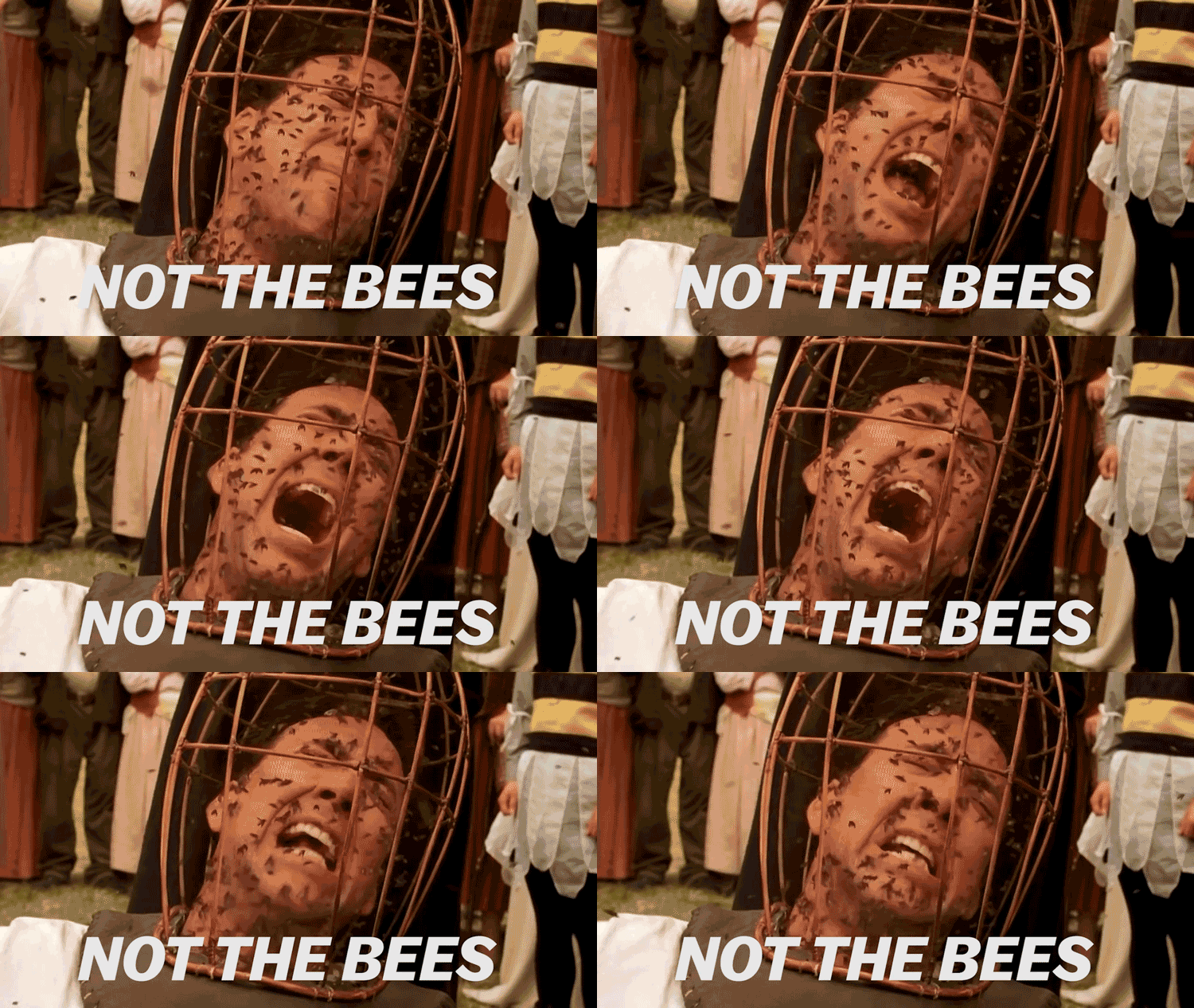
In conclusion: bees.

nicolascage_notthebees-0

Posted in episodes, homework

Episode 6: Sacrifice

The homework for the episode:
Pete: X2: X-Men United (movie)
Martha: Puella Magi Madoka Magica: Beginnings (movie)
Calee: The Last Unicorn by Peter S. Beagle (book)

It’s here! It’s here! Martha takes a victory lap when Pete admits that one of these items is his most favoritest homework he’s been assigned yet (which one may surprise you), we argue intent of story versus intent of character, Calee feels skeptical about deconstructed magical girls, and we once again forget to talk about Logan even though it’s apparently relevant to absolutely everything we’re doing anymore.

Your podcasters’ credentials:
Pete: Hour of Code (check it out here!)
Martha: Mad Men, season six
Calee: Star vs. the Forces of Evil (tv show)

Sacrifice – Additional Material
The Expanse (tv series on SyFy)
Frozen
The Hunger Games
 (book or movie)
His Dark Materials trilogy by Philip Pullman
Mass Effect 3 (video game)
The Matrix
Rogue One: A Star Wars Story
Supernatural,
episodes 3.16, 4.20, 5.10, 5.22
– (Look, this whole show is people falling over themselves to die for the greater good. I picked a handful of episodes that stand out as being particularly meaningful examples of the theme. -Martha)
The Twilight Saga 
by Stephanie Meyer

Our theme for our next episode is going to be: Alternative Facts: How We Relate to, and Experience, News Media. Enjoy doing your homework!

Your homework for April 12:
Pete: The West Wing, episode 1.13: “Take Out the Trash Day”
Martha: Shattered Glass, 2003 film starring Hayden Christensen
Calee: Harry Potter and the Order of the Phoenix by J.K. Rowling (book)